Winter Soldier Testimony
Panel Fernando Braga and film of civilian testimony
-
-
-
-
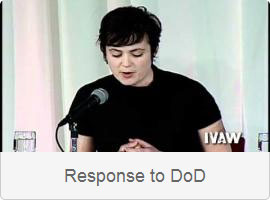
Panel Kelly Dougherty On March 15th, the Washington Post reported the DOD response to IVAW's Winter Soldier testimony:
A Defense Department spokesman said he had not seen the allegations raised yesterday but added that such incidents are not representative of U.S. conduct.
"When isolated allegations of misconduct have been reported, commanders have conducted comprehensive investigations to determine the facts and held individuals accountable when appropriate," Lt. Col. Mark Ballesteros said.
Kelly Dougherty, IVAW's Executive Director responds in this statement.
Panel Kelly Dougherty Winter Soldier and the Legacy of GI Resistance Kelly Dougherty, IVAW’s executive director, served as a medic and MP with the Colorado Army National Guard in the Balkans and Iraq. A co-founder of the organization, she was spurred on by her firsthand knowledge of the damage the occupation causwa to Iraqis, the U.S. military, and the men and women she served with. Speaking of what compelled her to become involved, she says of the veterans and their supporters at Winter Soldier, “We’ve been transformed in our own lives and feel like we have a responsibility to continue fighting, to uphold values that we took very seriously when we enlisted or that came to be very important to us through our service.”
Dougherty reiterates IVAW’s three goals: immediate withdrawal of all occupying forces from Iraq, full benefits and healthcare for returning veterans, and reparations and compensation for the people of Iraq. She notes that, like the winter soldiers lauded by Thomas Paine, the testifiers this weekend are continuing a legacy of veterans and soldiers speaking out against unjust, inhumane, and damaging policies.
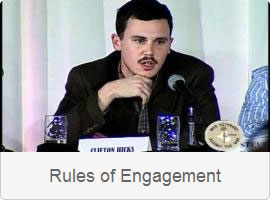
Panel Hart Viges Rules of Engagement: Part 1 It was just after 9-11 when Hart Viges joined the Army and the start of the occupation when he entered Iraq in March 2003. As a mortar man, he had his first taste of what he calls the loss of humanity that comes with war, when he helped set up rounds aimed at civilian neighborhoods in a small town on the way to Baghdad. He felt his humanity further slipping away when he fell into the habit of labeling everything with the racist epithet, "hadji." His testimony includes stories of raids on the wrong houses, which resulted in prolonged detention of innocent people, and his refusal to pose for a photo with a dead Iraqi man found lying in the road, not because he was disturbed by the death, but because it wasn't his kill. Later, he found a moment of clarity in the midst of chaos. Training his gun site on the face of a man standing in a doorway with an RPG strapped to his back, he saw an expression of fear and confusion that he understood to mirror his own. He didn't pull the trigger.
-
Panel Joshua Casteel - introduction
|